We see this symbol everywhere: on jewelry, clothing, tattoos, logos. We often associate it with an idea of combat: Good against Evil, Light against Darkness, Day against Night.
But this vision is a mistake.
In Traditional Chinese Medicine, Yin and Yang are not at war. They are complementary. One cannot exist without the other, one cannot be defined without the other. And it's this movement that makes life.
The origins of the Yin and Yang symbol
Before being a symbol or a philosophy, Yin and Yang were first an observation.
If Yin and Yang are today often associated with Taoism, they were not born with it. Their origin is much older. It's an idea that emerged more than 2,500 years ago from the observation of nature: the sunny slope and the shady slope of a hill, as well as the fact that everything is nothing but change. It was only much later that these observations were formalized by the Yin-Yang school, before being taken up and enriched by Taoism and Confucianism.
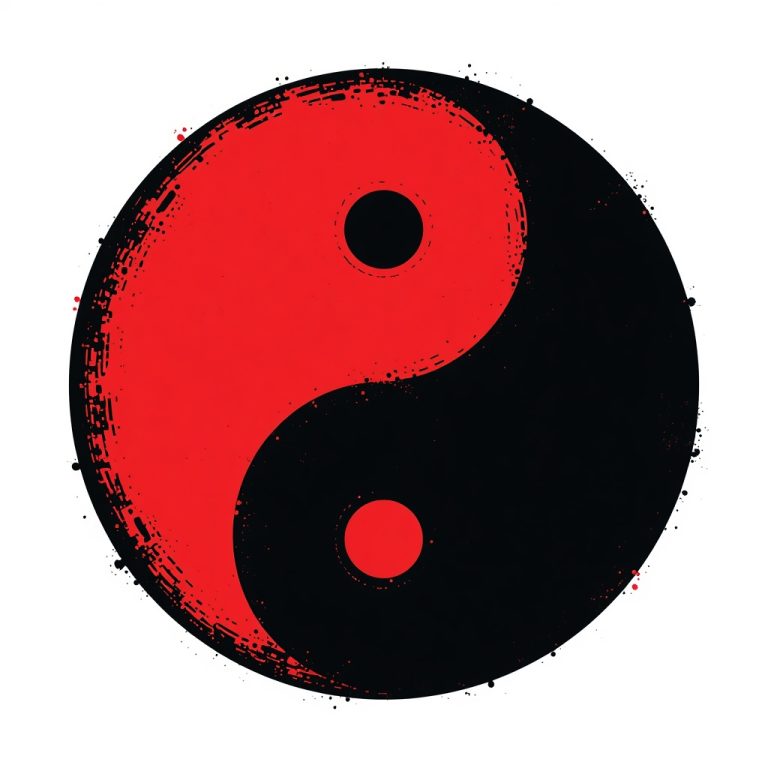
The symbol we know today is not the original. Originally, it was red and black, red for Yang, black for Yin.
It was in the 17th century, thanks to missionaries like Matteo Ricci, that this symbol was discovered in the West.
But observing it, they projected onto it their own vision of good against evil. It's also at this time that it took the black and white form we know, a simplified version, which has often lost its history along the way.
Yin Yang, what is it?
Contrary to the received idea, Yin and Yang are not a fight between good and evil.
They are above all comparison tools. They make it possible to say that one thing is more Yin or more Yang than another, according to its characteristics.
For example, the sun is more Yang than the moon: it's brighter, hotter, more mobile. The moon is more Yin: it's colder, calmer, more reflective.
In the same way, intense physical activity is more Yang than calm reading. A spicy meal is more Yang than a light soup. Nothing is totally Yin or totally Yang: everything is a question of proportion and context.
We too have Yin or Yang tendencies. We often say that men are more Yang and women more Yin. But that's a generality. A woman can very well speak loudly (Yang behavior) while a man can speak softly and be shy (Yin behavior).
And because everything is relative, Yin and Yang are also a question of movement. Nothing is fixed. What is Yang today can become Yin tomorrow. Day is Yang, night is Yin. Summer is Yang, winter is Yin. Everything changes, everything balances out.
It's possible to be shy at one moment in one's life (Yin), then to become more sociable later (Yang). I had actually written an article about character patterns, which explores this same idea from another angle. I invite you to re-read it if the subject interests you.
This idea of comparison and impermanence is essential to understand how Yin and Yang apply to our body, our emotions and our health.
And when this balance breaks, when one is too Yang (agitated, tense) or too Yin (tired, apathetic), the body sends signals. That's what we'll see in the next part.
The gentle balance within us
"The fish doesn't know the word water." Taoist proverb.
This quote actually speaks of the great Whole that Taoism refers to. It indicates that, like the fish, we live in a great Whole, the great ONE, unicity. And that there is no separation between things and beings.
We are identical to this person with whom we are in conflict. The boar that the hunter kills: both are part of the same whole. Just like us and the plants. Us and the mountains.
But this unicity is not visible. A bit like the Force in Star Wars, it's all around us, and within us, and we don't see it. We are not aware of its existence.
But we can perceive it. Thanks to the number two, thanks to duality. Thanks to Yin and Yang.
I have read several legends about the perfect balance between Yin and Yang.
The first, told by Mr. Eric Marié, says that originally lived immortal men. They had such mastery of the balance of Yin and Yang that their body did not decay. But time passed, and this fine knowledge was gradually lost. Over the centuries, man became mortal, and disease made its appearance. The balance within them had broken.
Jean Motte, for his part, develops a different idea. For him, the perfect balance of Yin and Yang is death. But one must get close to it to live in good health.
These stories from the past all remind us of the same thing: the balance of Yin and Yang within us is paramount.
To help us preserve or restore this balance, Traditional Chinese Medicine offers four pillars: acupuncture, nutrition, pharmacopoeia and massage. By practicing them, we stay healthy.
But before entering into the detail of these practices, let's start by understanding how Yin and Yang express themselves in our body on a daily basis.
How Yin and Yang act within us
We've just seen that Yin and Yang are above all tools to perceive the world, to understand that everything is linked. But this perception doesn't stop at philosophy. It also applies to ourselves, to our body, to our health.
In Traditional Chinese Medicine, the human body is considered a microcosm. What happens in the universe is reflected in us. Seasons, cycles, temperatures… everything has its equivalent inside our organism.
Yang represents hot, active energy, which allows us to act, to move, to think, to digest. It's our "engine". Yang is linked to what is superficial, to the skin, to the body's defense functions (what is called in TCM the protective Qi. A notion I often talk about in consultation).
When Yang is strong, we are dynamic, we feel warm, we digest well.
Yin, on the contrary, is the calm, nourishing energy, which allows us to rest, to sleep, to regenerate. It's our "reservoir". Yin is linked to what is deep: organs, bones, marrow, blood.
When Yin is sufficient, we sleep well, we are relaxed, we have a good recovery capacity. At night, when darkness falls, our Yin activates. It's the moment to slow down, to rest, to sleep.
Yin and Yang: a dynamic balance
But careful, Yin and Yang are not two fixed blocks that we would own in definitive quantities. They are in constant interaction. During the day, we draw on our Yang to act. And at night, Yin comes to repair and recharge Yang.
That's why it's as important to sleep well as to be active. The quality of sleep largely determines our energy the next day. If our Yin is too weak (we sleep badly, we're exhausted), our Yang won't have the resources to function properly. We risk burning out, falling ill. It's a vicious circle.
What are the signs of an imbalance
How to know if our Yin or our Yang is imbalanced? The body sends us signals.
An excess of Yang (or a deficit of Yin) can give:
- sensations of heat, hot flashes.
- insomnia (especially early or restless awakenings)
- irritability, anxiety, a feeling of being "tense"
- a red tongue, excessive thirst
- dry skin
An excess of Yin (or a deficit of Yang) can give:
- a feeling of cold, cold extremities
- permanent fatigue, a feeling of "heaviness"
- digestive disorders (bloating, lack of appetite)
- a pale tongue, a dull complexion
- a craving for sugar or comfort food
The body speaks to us
What I observe at the practice is that we often tend to ignore these signals.
A back pain, a blocked neck, chronic fatigue, nightly awakenings… these are not fatality. They are messages. The body tells us that our balance is broken, that it's time to slow down, to listen to ourselves, to be nourished differently.
Traditional Chinese Medicine doesn't seek to "cure" an isolated pain, but to understand the terrain, to see where the balance has broken, and to accompany the body so that it finds its own balance again.
To conclude
To conclude this article on Yin and Yang, let's recall that it was created to talk about Qi, about energy. A notion that one can neither see nor feel. But which exists, otherwise we would not be alive.
Some people manage, however, to perceive this energy. The wind in the trees, a sunbeam, a stomach that bloats… all of this is nothing but the emanation of energy.
So what to deduce for our daily life? Perhaps it's necessary to be more in observation. Of our environment. Of nature. Of the strangers we cross every day. Of our loved ones. And above all, of ourselves.
The balance of the Yin and Yang energies within us is a work of every instant. Difficult sometimes, but which, in the end, makes us healthier.
To get there, I remind you of the 4 pillars of Traditional Chinese Medicine: energetic practice, massage, nutrition, pharmacopoeia. And without forgetting Qi Gong for gentle physical activity.
By following these principles, you will surely fall ill less often, in the energetic sense, and you will live longer. One only has to look at the number of centenarians in Asia: especially in Japan.
And you, do you feel rather Yin or Yang today?
You feel your Yin-Yang balance is broken?
Fatigue, agitation, insomnia? As a TCM practitioner in Courbevoie, I offer you a complete energy assessment to identify your imbalances and restore harmony.