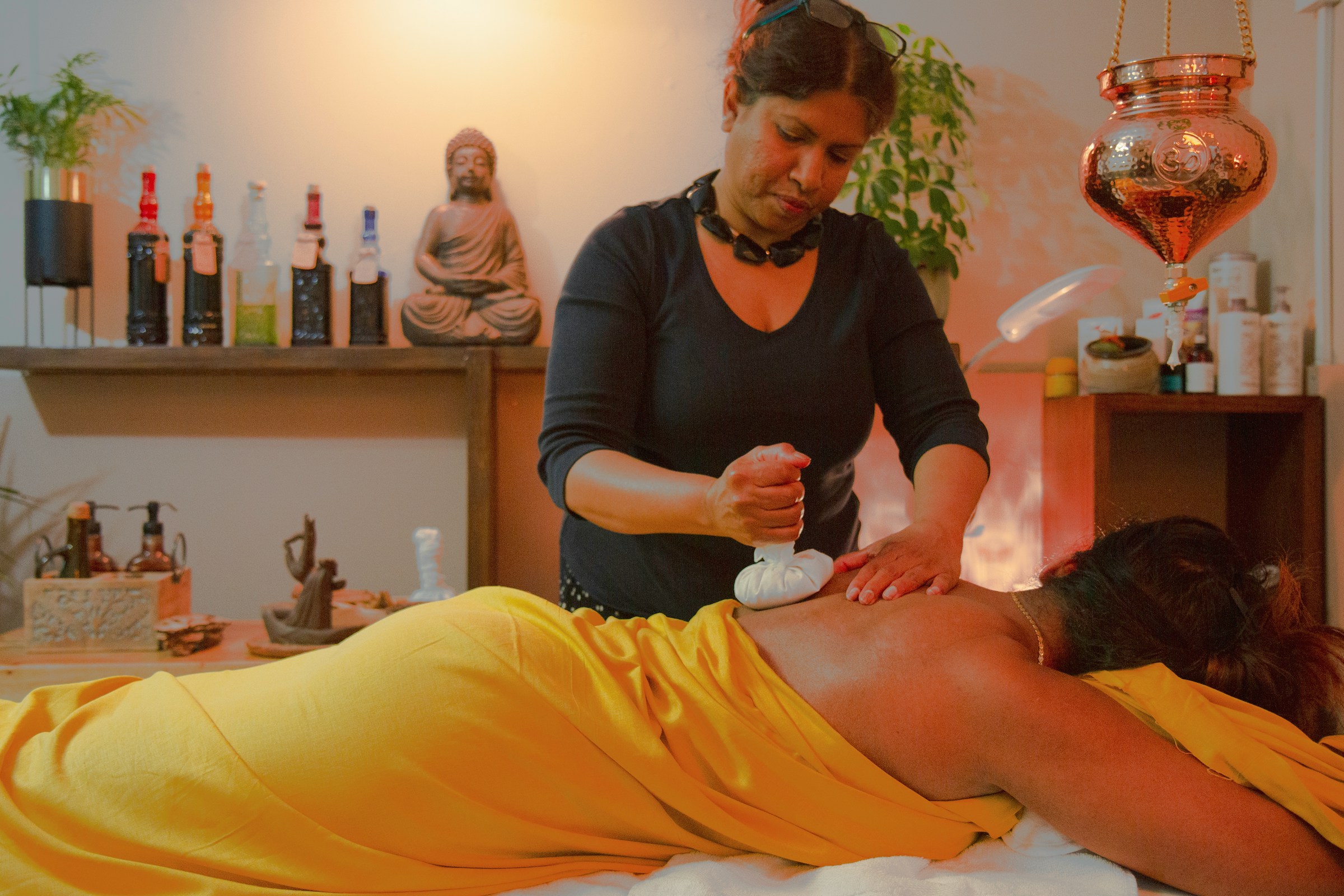
Thai massage, or Nuad Bo'Rarn, is an ancestral practice that harmonises the body and the mind, a true art of touch. It is practised on the floor, on a futon, and you remain fully clothed: no oil, loose and comfortable clothing is enough.
Often described as "passive yoga", it alternates rhythmic pressures along the energy lines and guided stretching that you simply receive. You come out both relaxed and surprisingly toned, like after a good stretching session, without having made the slightest effort.
Why choose Thai massage?
Thai massage can bring you:
- A deep release of stress and accumulated tensions
- Better joint mobility, especially in the back, shoulders and hips
- A rebalanced energy circulation, to regain vitality and lightness
- An improved posture thanks to the gentle stretching
- A soothed mind, as after a meditation session
I particularly recommend it to:
- Stressed or overworked people
- Sedentary workers or those subject to repetitive gestures
- Athletes wishing to improve their flexibility
- Travellers and people who feel heavy legs
- People who do not like oil or prefer to remain clothed
- Anyone curious to discover a holistic approach to wellbeing
Prices and durations
| Duration | Price | Ideal for |
|---|---|---|
| 1h | 80€ | Optimal duration: a complete sequence, from head to toe |
| 1h30 | 115€ | Deeper and more immersive experience, more stretching and a slower pace |
The 1h session is the duration I advise for a first discovery: it allows you to cover the whole body without rushing. The 1h30 version is for those who wish to go further in the flexibility work or extend the relaxation.
How a session works
On arrival, a chat allows us to understand your expectations, your tension areas and to rule out any contraindication. You wear loose clothing (like jogging and a t-shirt), I can lend you some if needed.
You settle on the futon. The session generally begins with the feet and legs, with slow pressures of the palms and thumbs along the energy lines (sen). The stretching then follows: I mobilise your legs, hips, back and arms in yoga-inspired postures, using my own weight rather than force. You have nothing to do, simply breathe and let yourself be guided.
The work continues on the back, shoulders, neck and ends with the face and skull, for complete soothing.
A time to return to calm is granted at the end of the session, accompanied by a warm drink.
The two schools of Thai massage
There are two great traditions:
- The Northern style (Chiang Mai), softer and more meditative: slow pressures along the energy lines (sen), very close to the meridians of traditional Chinese medicine, and stretching close to yoga. Ideal for deep relaxation.
- The Southern style (Bangkok), more dynamic: rhythmic pressures with the palms, thumbs and forearms, and energising joint mobilisations.
In my practice, I draw on these two traditions to create tailor-made sessions, always attentive to your needs and how you feel. My touch adapts to each person, combining gentleness and tonicity according to the moments.
Contraindications
Your safety is my priority. Thai massage is not recommended in the following cases:
- Fever or acute inflammation
- Unstabilised heart problems
- Phlebitis or significant varicose veins
- Severe osteoporosis
- First trimester of pregnancy
- Recent surgery
- Cancer
Before each session, I take the time to discuss with you to make sure the massage is adapted to your situation. Feel free to tell me about any medical particularity: confidentiality is of course guaranteed. When in doubt, ask your doctor for advice.
History of Thai massage
Nuad Bo'Rarn has its roots more than 2 500 years ago in India, with the physician Jivaka Kumar Bhaccha, a contemporary of Buddha and considered the father of traditional Thai medicine. He is still honoured today in Thailand, and many practitioners address him a short prayer before starting a massage.
Over the centuries, this practice was enriched in Thailand, blending Ayurvedic influences, energy principles and Buddhist philosophy, in particular the notion of metta, the kindness that must animate every gesture of the practitioner.
Originally reserved for monks in the temples, Thai massage progressively spread to the people, becoming a pillar of Thai culture. The Wat Pho temple, in Bangkok, remains its historical centre: its walls still bear engravings of the energy lines dating from the 19th century. In 2019, UNESCO inscribed Nuad Thai on the Intangible Cultural Heritage of Humanity.
Frequently asked questions
Do I need to undress?
No. Thai massage is practised fully clothed, without oil, in loose and comfortable clothing. I can lend you some if needed.
Is it painful?
No. The pressures and stretching are progressive and adapted to your flexibility. You remain free to tell me at any time if a position is uncomfortable.
Do I need to be flexible?
Not at all. The stretching is carried out at your pace and within your limits. It is precisely the massage that, session after session, helps you gain flexibility.
What is the difference with Swedish massage?
Swedish massage is practised on a table, with oil, with gliding movements. Thai massage is practised on the floor, fully clothed, and combines pressures and stretching. The former is rather enveloping, the latter rather tonifying.
Which duration should I choose?
1h (€80) is the optimal duration for a first session. 1h30 (€115) allows a deeper and more immersive experience.
Are there any contraindications?
Yes, particularly in cases of heart disorders, phlebitis, severe osteoporosis, recent surgery or first trimester of pregnancy. A chat at the start of the session allows me to check that the massage suits you.
Can I offer it as a gift?
Yes, contact me to arrange a personalised gift voucher.