
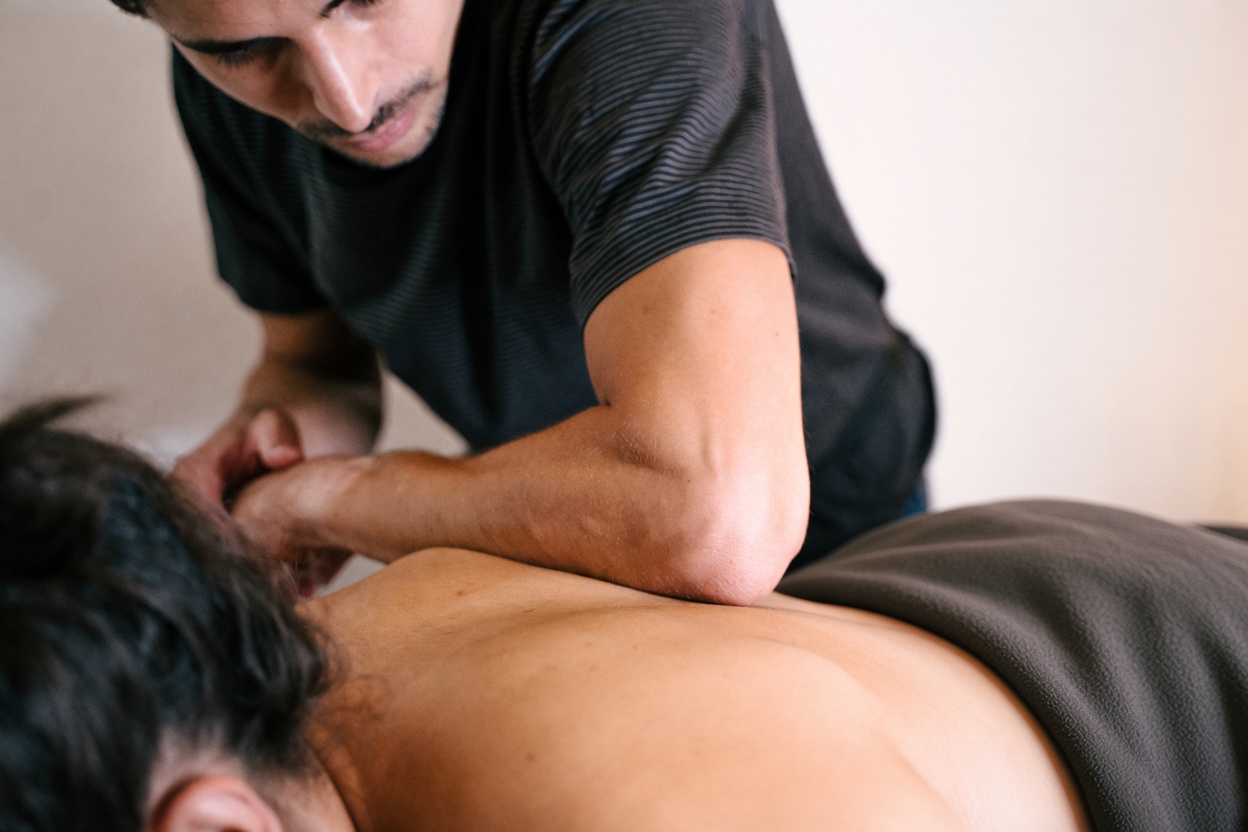
Deep tissue massage is an in-depth work on the muscles and fascia, designed to respond to chronic pain, support sports recovery or release physical tension linked to stress. It is an intense pressure, sometimes uncomfortable at the moment, but whose liberating effect is immediate.
⚠️ This is not a classic relaxation massage: some areas may be sensitive during the session.
Who it is for, and what for?
Contrary to popular belief, deep tissue is not reserved for athletes. I particularly recommend it for:
- Chronic pain: lower back pain, neck pain, locked shoulders, often linked to stress or sedentary work
- Sports recovery: for runners, swimmers, CrossFit practitioners, work on post-exercise muscle tension
- Stress-related tension: certain tensions anchor in the body (back, jaw); deep pressure can help release them
- Post-operative recovery (with prior medical approval)
Prices and durations
| Duration | Price | Ideal for |
|---|---|---|
| 1h | 80€ | One specific area (shoulders/neck or lower back): perfect for discovering deep tissue |
| 1h30 | 115€ | The most requested format. Several areas (back + legs), with discussion and post-session advice |
| 2h | 150€ | Full-body work or monthly follow-up, with guided stretching |
Wellness package: 5 sessions, -10%.
How a session works
Each session begins with a discussion to understand your needs and check the absence of contraindications. I then adapt my pressure and my techniques according to your tension areas: never two identical sessions.
The techniques I use
Deep tissue is not a single method. I combine several approaches according to your needs:
Trigger Point Therapy
Identification and manual release of trigger points (areas of radiating tension), particularly useful for migraines or sciatica-type pain.
Neuromuscular Technique
Combination of pressure and stretching to rebalance hypertonic muscles. Appreciated by athletes after intense training.
Myofascial Release
Work on fascia adhesions, essential for regaining mobility after an injury.
Contraindications
As this practice is intense, certain situations require postponing or adapting the session:
- Phlebitis, thrombosis or severe circulatory disorders
- Fever or acute infection
- Recent fracture or advanced osteoporosis
- Recent surgery
- Cancer undergoing treatment
- Pregnancy
- Unstabilised herniated disc
- Irritated skin or burns
A prior assessment is systematically offered. Feel free to report any medical history.
After the session: what you need to know
Remember to hydrate well after the session and to plan a moment of rest. Some muscle soreness in the following 24 to 48 hours is normal and reflects the deep work carried out.
History of Deep Tissue Massage
Although recently popularised, deep tissue is based on ancient practices: Greeks and Romans already used deep pressure methods to relieve soldiers and athletes.
In the 20th century, therapists such as Ida Rolf (founder of Rolfing) structured systematic approaches to work on the fascia and posture. Today, deep tissue incorporates knowledge from functional anatomy, physiotherapy and myofascial release techniques.
Frequently asked questions
Is deep tissue massage painful?
The pressure can be uncomfortable at the moment, especially on tension areas, but it should never be unbearable. I always adapt to your tolerance level.
Do I need to be an athlete to benefit from it?
No, deep tissue is adapted to anyone suffering from chronic pain or muscle tension, whether athletic or not.
How many sessions do I need?
For chronic pain, a series of 3 to 5 sessions is often recommended. For maintenance, a monthly session is usually enough.
Is muscle soreness normal?
Yes, slight muscle soreness in the following 24 to 48 hours is normal. It testifies to the deep work carried out on the tissues.