Heavy legs, a feeling of swelling, pronounced cellulite, persistent fatigue… These symptoms often have one thing in common: a slowed lymphatic circulation. Manual lymphatic drainage is a gentle, slow and rhythmic massage technique that supports the natural movement of lymph through the body.
The essentials in 30 seconds
- A very gentle manual massage technique that re-launches lymph circulation with slow, rhythmic movements.
- Helpful for heavy legs, water retention, swelling and feelings of fatigue.
- Session of 1h to 1h15, 80 €, at the practice in Courbevoie or at home.
- Not recommended in case of phlebitis, acute infection, or during the first trimester of pregnancy.
1. Prices and practical information
- Single session: 80 €
- Pack of 10 sessions: 720 € (1 session free)
📍 Practice in Courbevoie, also at home and in companies
2. Who is it for, and when?
Lymphatic drainage is especially suited to you if you:
- feel heavy legs at the end of the day;
- work standing up or sitting for long hours;
- tend to swell in the heat;
- are coming back from a long flight or car journey;
- want to prepare your body before an event (wedding, summer season);
- are simply looking for a moment of deep relaxation.
3. What is lymphatic drainage?
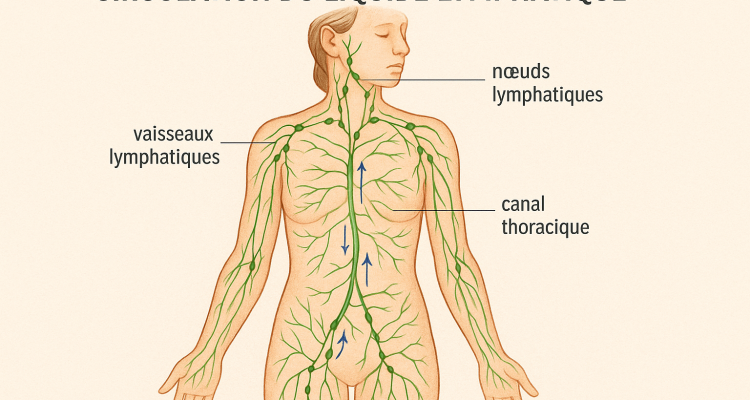
The lymphatic system is a network of vessels and nodes that runs through the whole body, parallel to the blood system. It carries lymph, a clear fluid charged with cellular waste, proteins and white blood cells.
Its particularity: it has no pump. Unlike blood, propelled by the heart, lymph circulates thanks to muscle contractions, breathing and body movements. A sedentary lifestyle, prolonged standing, heat or a long flight are enough to slow it down, hence that feeling of swollen legs at the end of the day.
Manual lymphatic drainage compensates, from the outside, for this absence of a natural pump.
4. The benefits of lymphatic drainage
- Reduction of water retention and oedemas.
- Improved blood and lymph circulation.
- Reduced appearance of cellulite and a slimmer silhouette.
- Strengthened immune system.
- Deep relaxation and improved skin quality.
- Relief from the feeling of heavy legs.
5. How a session works: my 3-level protocol
For a complete effect, I work with progressive depth:
- Superficial: activation of the lymphatic vessels on the surface.
- Intermediate: stimulation of the nodes and re-activation of the flow.
- Deep: work on the subcutaneous tissues to drain all the affected areas.
6. Recommended frequency
For visible and lasting results, I recommend 2 sessions a week at the start, then a monthly follow-up.
7. Contraindications
Lymphatic drainage is not recommended in case of:
- acute infection;
- phlebitis or thrombosis;
- uncontrolled heart problems;
- active cancer (except with favourable medical advice);
- first trimester of pregnancy.
If you have any doubt about your situation, talk to your doctor before booking an appointment.
8. Maximising the effects between sessions
- Drink regularly, but without excess.
- Move: walking naturally stimulates lymph circulation.
- Avoid prolonged standing right after a session.
- Prefer a low-salt diet in the following days.
9. The different forms of lymphatic drainage
- The Vodder method: the most classic, with circular and pumping movements.
- The Leduc method: more focused on re-launching the lymph by working on the nodes.
- Mechanical lymphatic drainage: performed with devices such as pressotherapy.
10. The types of tissue concerned
- Aqueous tissue: water retention, swelling.
- Adipose tissue: cellulite, accumulation of fat.
- Fibrous tissue: scars, pronounced cellulite.
11. The history of lymphatic drainage
Manual lymphatic drainage (MLD) was developed in the 1930s by Dr Emil Vodder, a Danish physiotherapist, with his wife Estrid.
Based on the French Riviera, they received many British patients suffering from chronic respiratory infections, with systematically congested neck nodes. Vodder tried gentle, circular manoeuvres on these areas, and observed a clear improvement in his patients' general condition.
The couple presented their method in Paris in 1936. It then spread across Europe, integrated into physiotherapy, then into wellness and aesthetics.
FAQ
Does lymphatic drainage make you lose weight?
No. It acts on water retention, not on fat mass.
Is it painful?
No, it is one of the gentlest techniques that exist.
How long do the effects of a session last?
From a few hours to several days, depending on your constitution and lifestyle.
Can it be done during pregnancy?
Not during the first trimester. After that, only with your doctor's or midwife's agreement.
Do you need to drink a lot after the session?
Drink normally, but regularly.